I've now had the working F170 up to its 80°C chamber temperature. What struck me was how little of that heat seemed to reach the outside of the machine. The outer door glass didn't feel warm, and I couldn't detect a temperature increase by touching the sides or back.
The top lid felt perhaps around 30°C, with the space above the thermal shield comfortably below 35°C by my estimate. These were informal impressions rather than instrumented measurements, but they made the insulation and separation between the chamber and gantry feel like a very worthwhile starting point.
My aim is still a chamber capable of 120°C. I'll need to measure what happens around the components as I work towards that, but this first warm-up was encouraging.
A useful discovery in the carriage
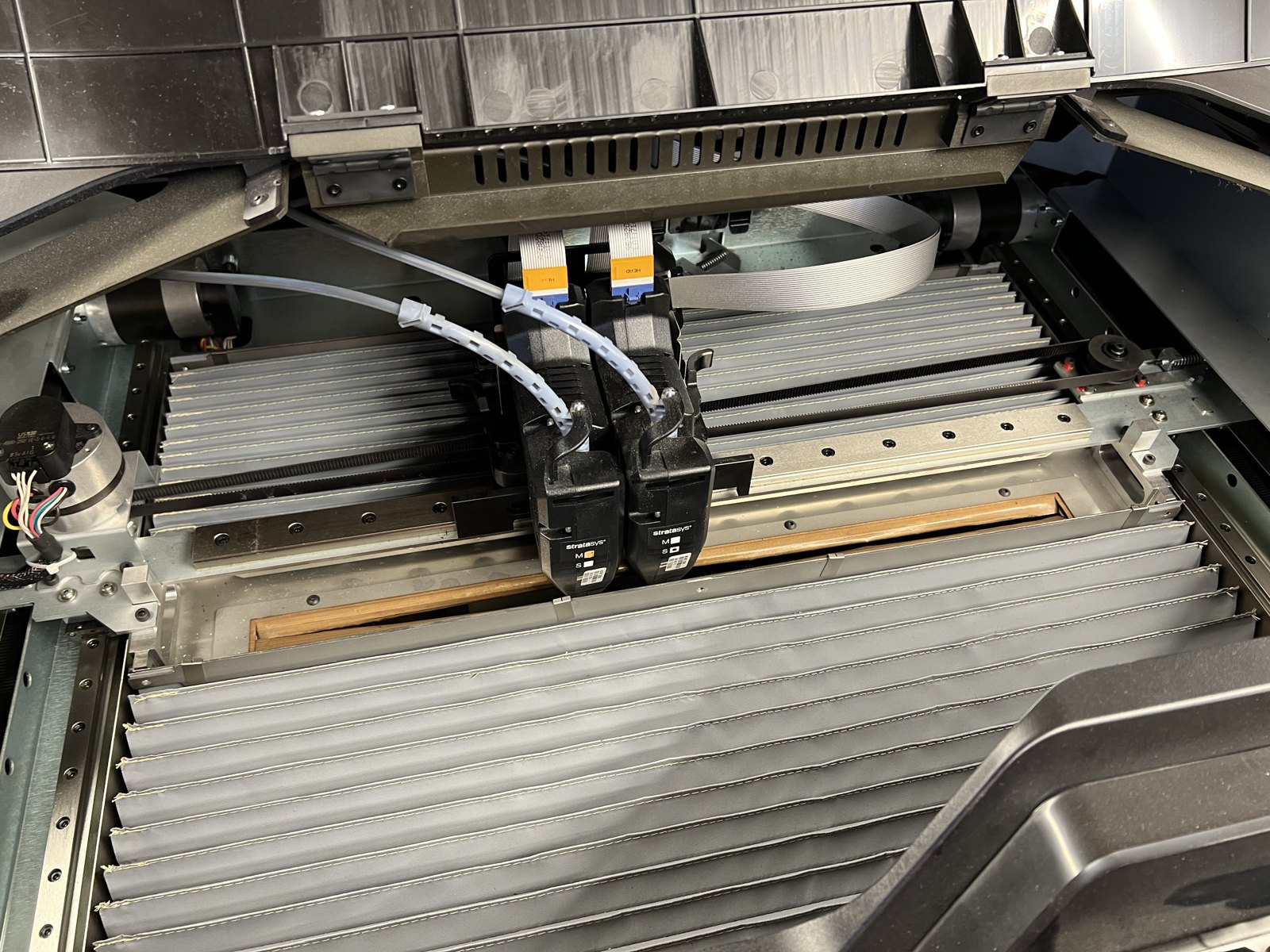
The quick-release printhead carriage is very nicely engineered. It looks as though I could make an adapter to mount an open-source extruder in one of the existing positions.
More interestingly, the right-hand head already has a lift mechanism built into the carriage. A sliding bar across the front is operated by moving to the X limits. Keeping that could save me designing a lifting system from scratch, and makes the dual-nozzle route much more appealing.
I'd use the second nozzle for support material. That puts the emphasis on reliable lifting, clearance and repeatable alignment. Camera-assisted nozzle alignment is something I've been looking into, but the carriage and adapter design come first.
Space versus a second nozzle
I measured an available area of roughly 410 × 300 mm, with about 50 mm of width likely to be lost if I keep the dual-nozzle setup. The final usable area will depend on where the new nozzles sit and how I build the bed.
I'm still weighing that trade-off. For now, the more I look at the original carriage, the more inclined I am to find a way to work with it. There is a lot here worth keeping.
